What Is an ERP? Why Every Growing Business Should Be Using One
Running a business becomes more complicated as it grows. Sales increase, more employees join the company, inventory expands, customers expect faster service, and financial records become more difficult to manage. Many businesses respond by using different software for each department, such as one application for accounting, another for inventory, another for payroll, and spreadsheets for everything else.
While this may work in the beginning, it quickly creates problems. Information becomes scattered, employees spend time entering the same data multiple times, and managers struggle to get an accurate picture of how the business is performing.
This is where an Enterprise Resource Planning (ERP) system makes all the difference.
What Is an ERP?
ERP stands for Enterprise Resource Planning. It is software that combines all the important parts of a business into one centralized system.
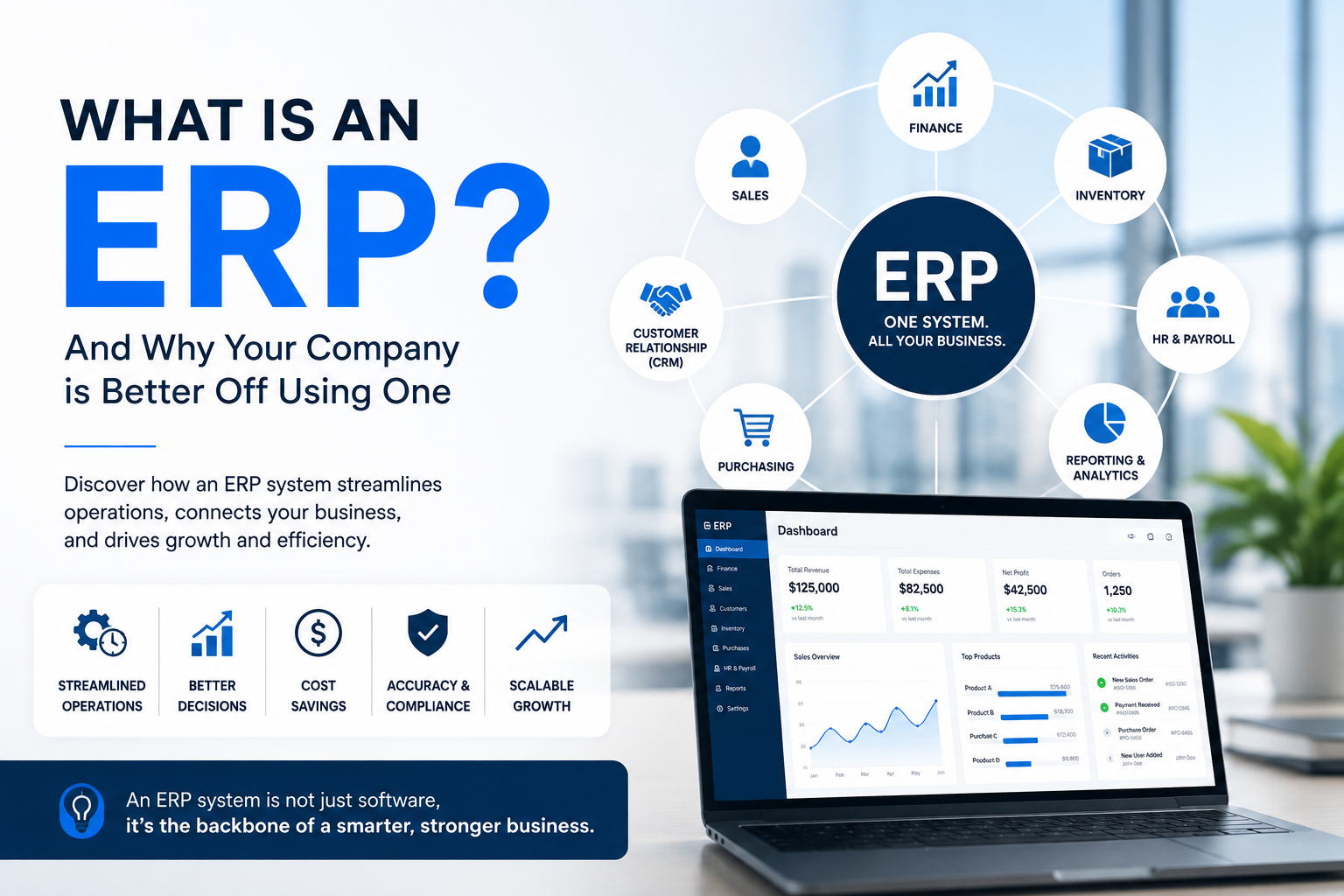
Instead of each department working with separate software, everyone works from the same database. This means sales, finance, inventory, purchasing, payroll, customer management, reporting, and other business functions are always connected.
When someone updates information in one department, it is immediately available everywhere else that needs it.
Think of an ERP as the central nervous system of a business. Every department remains independent, but they all communicate through one platform.
Why Businesses Need an ERP
Many companies experience the same challenges before adopting an ERP:
Information stored in multiple systems
Duplicate data entry
Time wasted switching between applications
Slow reporting
Inventory inaccuracies
Difficult financial reconciliation
Limited visibility into business performance
Human errors caused by manual processes
An ERP eliminates these problems by creating one source of truth for the entire organization.
How an ERP Works
Imagine a customer places an order.
Without an ERP, several departments may need to manually update their own systems.
With an ERP:
The sales team records the order.
Inventory updates automatically.
Finance generates the invoice.
The warehouse receives fulfillment instructions.
Management dashboards update in real time.
Customer history is instantly available for future interactions.
Everything happens from one connected platform without unnecessary duplication.
Key Benefits of Using an ERP
1. Improved Efficiency
Employees spend less time entering data and more time doing meaningful work. Automation handles repetitive tasks, reducing delays and increasing productivity.
2. Better Decision Making
Real-time dashboards and reports allow managers to make decisions based on accurate, up-to-date information rather than outdated spreadsheets.
3. Lower Operating Costs
Reducing manual work, duplicate software, and costly errors saves businesses money over time.
4. Increased Accuracy
Since information is entered once and shared across departments, there are fewer mistakes caused by duplicate data entry.
5. Better Customer Service
Employees have immediate access to customer information, order history, invoices, and support records, enabling faster and more informed responses.
6. Business Growth
As your company expands, an ERP grows with you. New users, departments, branches, and business processes can be added without rebuilding your systems from scratch.
7. Stronger Security
Modern ERP platforms include user permissions, audit trails, backups, and centralized data management to help protect sensitive business information.
Who Should Use an ERP?
ERP software is no longer just for large corporations.
Today, businesses of all sizes can benefit from using an ERP, including:
Retail businesses
Manufacturing companies
Wholesale distributors
Financial institutions
Schools
Healthcare providers
Construction companies
Service businesses
Logistics companies
Government organizations
Non-profit organizations
Whether you have 10 employees or 10,000, an ERP can help streamline operations and improve visibility across your business.
Choosing the Right ERP
Not all ERP systems are built the same.
When evaluating an ERP, look for features such as:
Modular architecture
Cloud access
Secure user management
Mobile accessibility
Custom reporting
API integrations
Automation tools
Scalability
Reliable support
Regular updates
A modular ERP allows businesses to purchase only the applications they need while adding more as they grow.
Why Dextersoft ERP?
Dextersoft ERP is a modern, cloud-based business management platform designed to help companies streamline operations without paying for software they do not need.
Unlike traditional ERP systems that force businesses to buy large software suites, Dextersoft ERP uses a modular approach. Companies simply choose the applications they require, such as:
Accounting
Point of Sale (POS)
Payroll
Loan Management
Bulk SMS Marketing
PDF Signing
Risk Intelligence
Inventory Management
Customer Management
Fiscalisation
And many more
As your business grows, you can add new modules without disrupting your existing operations.
This flexible approach keeps costs lower while ensuring your business has the tools it needs to scale efficiently.
Final Thoughts
An ERP is much more than business software. It is the foundation that connects people, processes, and information across an organization.
By replacing disconnected applications with one integrated platform, businesses become more efficient, make better decisions, reduce costs, and create a better experience for both employees and customers.
Whether your business is just beginning to grow or already manages multiple departments, investing in the right ERP can be one of the smartest long-term decisions you make.
If you're looking for a flexible, scalable solution that grows with your business, Dextersoft ERP provides the tools you need to manage your operations from one powerful platform.